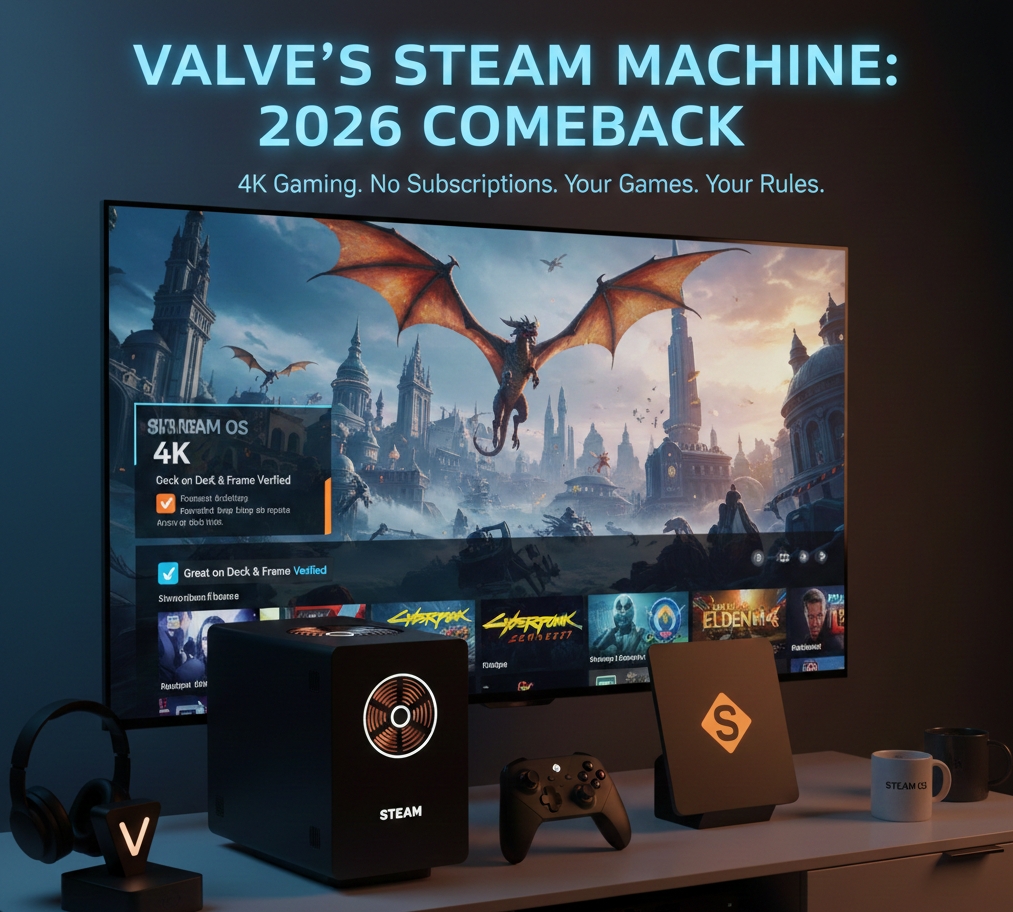
For a long time, the Steam Machine felt like one of gaming’s biggest “what ifs.” Launched too early and misunderstood by the market, Valve’s original attempt to bring PC gaming into the living room quietly faded away.
Now in 2026, that story is changing fast.
With the runaway success of the Steam Deck, a mature SteamOS, and growing frustration around closed console ecosystems, Valve is reportedly preparing a true second-generation Steam Machine—and this time, the timing may finally be right.
Here’s a fully updated, original breakdown of what the new Valve Steam Machine means, why it matters, and how it could reshape living room gaming.
The New Steam Machine (2026): What’s Different This Time?
Unlike the fragmented 2015 rollout that relied on third-party manufacturers, the 2026 Steam Machine is expected to be a first-party Valve product. That alone fixes one of the biggest issues of the past: confusion.
What Valve Is Aiming For
- A console-like PC built specifically for TVs
- Seamless controller-first SteamOS experience
- No Windows license, no bloat, no forced subscriptions
- Power that sits between consoles and high-end gaming PCs
Think less “small desktop PC” and more “Steam Deck philosophy scaled up for 4K TVs.”
SteamOS 4.0: The Real Star of the Show
Hardware matters—but SteamOS is the real reason the Steam Machine is back.
Why SteamOS Is Finally Ready
- Proton compatibility now supports the vast majority of Windows games
- Games often run as well or better than Windows
- Unified UI across Steam Deck, Steam Machine, and Steam Frame
- Designed for HDR, 4K scaling, and couch gaming
Valve has spent years quietly solving the Linux problem—and in 2026, most gamers won’t even realize they’re not on Windows.
Steam Frame: Valve’s Smartest Hardware Move?
Alongside the Steam Machine, Valve is expected to introduce a new device category: Steam Frame.
What Is Steam Frame?
- A thin-client streaming box
- Built for Steam Link and cloud gaming
- Designed for homes with a powerful PC elsewhere
- Small, affordable, silent, and energy-efficient
Instead of forcing everyone to buy expensive hardware, Valve is giving users multiple ways to enter the ecosystem—a move straight out of the Steam Deck playbook.
Performance Expectations: Can It Really Do 4K Gaming?
Leaks and developer chatter suggest Valve is targeting:
- AMD-based custom APU
- RDNA 4-class graphics
- 4K / 60 FPS in most modern titles (with upscaling)
- Strong focus on FSR and system-level optimization
This won’t replace a $2,000 gaming PC—but it doesn’t need to. The Steam Machine is designed to compete with PS5 Pro–class hardware, not extreme PC builds.
Pricing Reality: The 2026 Hardware Problem
One challenge Valve can’t fully control is global component pricing.
In early 2026:
- RAM prices have surged
- SSD costs remain unstable
- Manufacturing margins are tighter than during the Steam Deck launch
As a result, analysts expect:
- Base models around $499
- Higher-end configurations pushing closer to $599
- Storage tiers to matter more than raw GPU differences
Even so, no subscription fees and cheaper games could make it the better long-term value.
Why Gamers Are Suddenly Paying Attention
Search interest around Steam Machine has exploded in 2026, driven by a few key frustrations:
- Rising console prices
- Mandatory online subscriptions
- Locked ecosystems and storefronts
- Limited hardware flexibility
The Steam Machine answers all of these with a simple pitch:
“Your games. Your hardware. Your rules.”
Steam Machine vs Consoles: The Real Difference
This isn’t about raw power—it’s about freedom.
With a Steam Machine, users get:
- Full access to Steam sales
- Mods and community content
- Mouse, keyboard, controller, or hybrid input
- Emulation and non-Steam apps
- Optional desktop mode for productivity
It’s not just a console alternative—it’s a different philosophy.
Final Verdict: Valve’s Quiet Power Play
The 2026 Steam Machine isn’t trying to dominate headlines. It’s doing something more dangerous: solving problems gamers are already tired of.
Valve waited. Valve learned. And now, with SteamOS matured and trust rebuilt through the Steam Deck, the company may finally be ready to claim the living room.
This time, the Steam Machine doesn’t feel early—it feels inevitable.