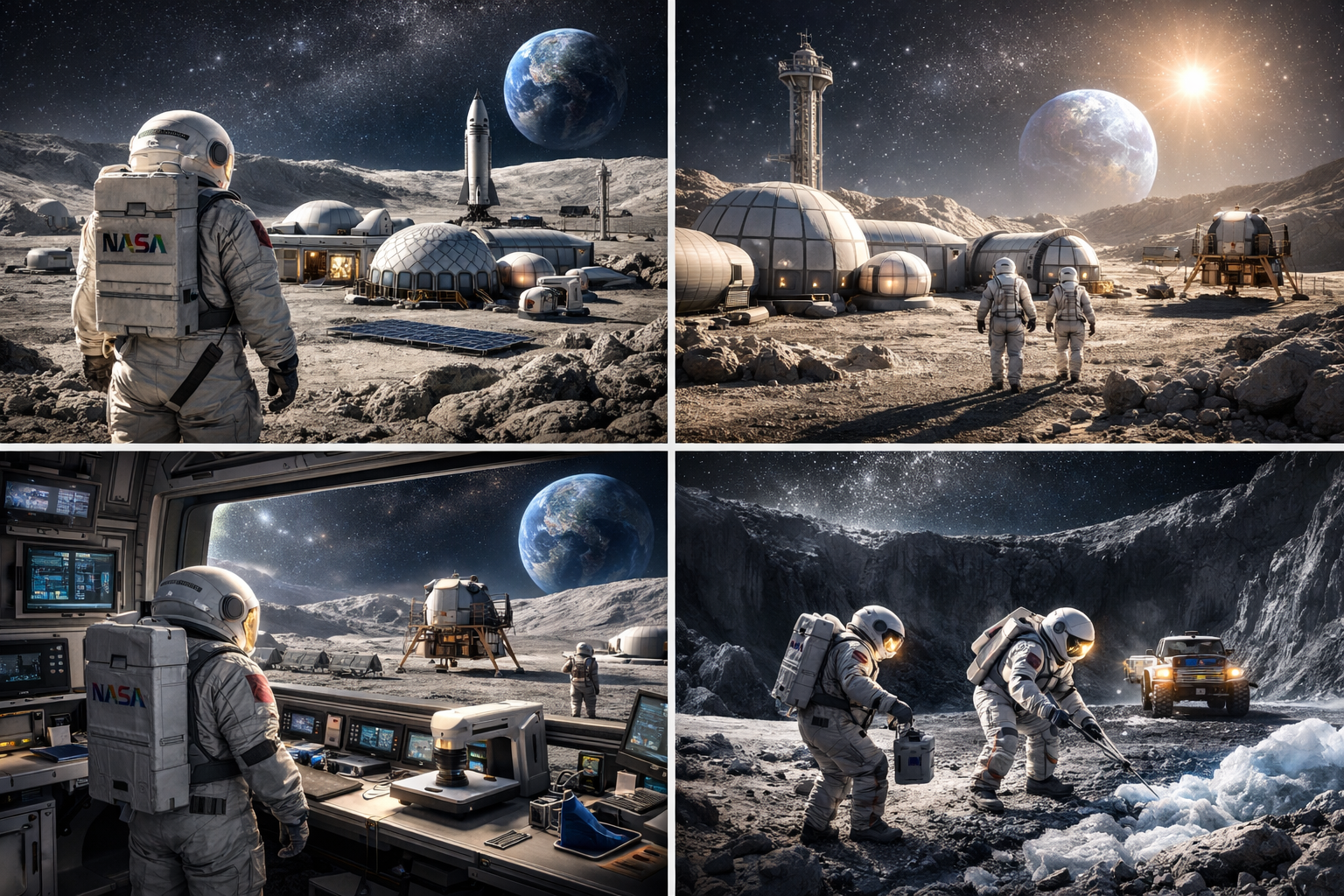
Nasa secret moon For decades, the idea of humans living on the Moon sounded like science fiction, but today it is closer than ever to becoming reality. NASA is actively working toward building a long-term lunar base that could allow astronauts to stay on the Moon for extended periods. This effort is part of the ambitious Artemis program, which aims not just to return humans to the Moon, but to establish a sustainable human presence there. Unlike the short missions of the Apollo 11 Moon landing, this new plan focuses on creating infrastructure that supports continuous exploration and habitation.
The concept of a Moon base goes far beyond a simple landing site. NASA is planning advanced habitats that could be built using 3D printing technology or inflatable modules, powered by solar energy, and equipped with life-support systems designed to keep astronauts safe in the harsh lunar environment. The agency is also collaborating with private companies like SpaceX to develop next-generation spacecraft capable of transporting both humans and cargo efficiently between Earth and the Moon. These innovations are critical for turning the idea of a lunar base into a functioning reality.
One of the most interesting aspects of NASA’s plan is the choice of location. The Moon’s south pole has been identified as the ideal site due to its unique conditions. Scientists believe this region contains significant amounts of water ice, which could be used for drinking water, oxygen production, and even fuel for future space missions. Additionally, certain areas near the south pole receive nearly constant sunlight, making them perfect for solar power generation. This combination of resources makes it possible to envision a semi-self-sustaining base that reduces dependence on Earth.
Despite these advancements, living on the Moon permanently is still a major challenge. Astronauts would have to deal with extreme temperatures, high levels of radiation, and low gravity, all of which pose serious risks to human health. However, NASA is developing new technologies and strategies to overcome these obstacles, including improved radiation shielding and advanced life-support systems. In the near future, astronauts may begin staying on the Moon for months at a time, gradually paving the way for longer missions and eventually permanent habitation.
The importance of building a Moon base extends far beyond the Moon itself. NASA views it as a crucial stepping stone for future missions to Mars and beyond. By testing technologies and survival strategies on the Moon, scientists can better prepare for the challenges of deep space exploration. Additionally, the Moon base could open up new economic opportunities, including space mining and even tourism, potentially creating an entirely new industry beyond Earth.
So, are humans moving permanently to the Moon? Not just yet. While a full-time lunar population is still years away, NASA’s current plans represent a significant step toward that future. The Moon is likely to become a hub for scientific research and space exploration rather than a place where millions of people live. Still, this marks the beginning of a new era in human history—one where living beyond Earth is no longer just a dream, but an achievable goal.